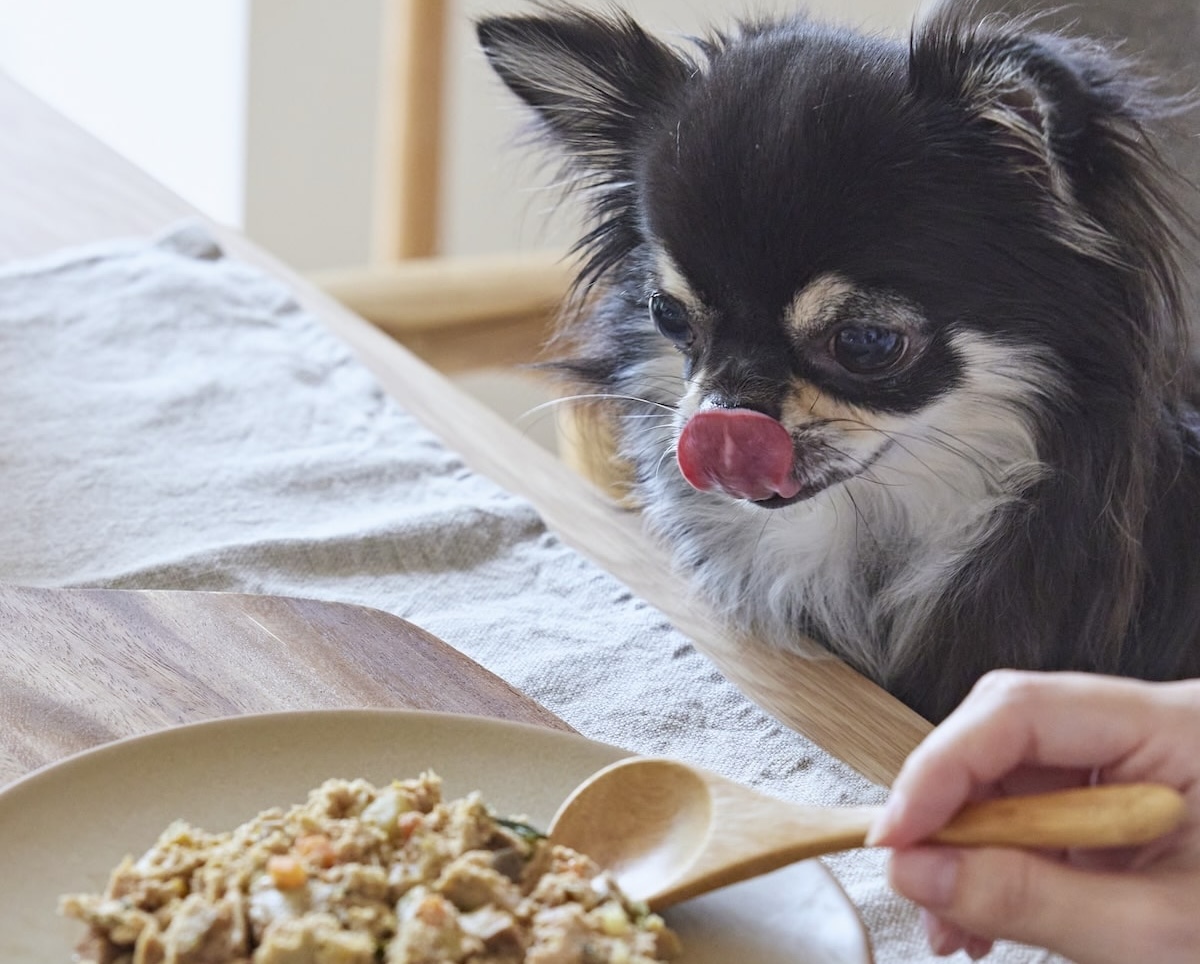
Small, medium and large dogs, 1 to 16 years, with calculator Dog Age Calculator
Updated 20 November 2026 · CoCo Gourmet editorial team
How old is your dog in human years? The old rule of multiplying by 7 is not accurate: dogs grow up very quickly in their first two years, and after that larger dogs age faster than small ones. This page has a dog age calculator and a chart from the American Kennel Club (AKC) for small, medium, large and giant dogs from 1 to 16 years old, explains the newer DNA-based formula from the University of California San Diego, sets out the life stages used by vets and when a dog counts as a senior, and shows how much to feed at each stage.
In short
A dog's age is not simply its age times 7. Guidance from the American Veterinary Medical Association (AVMA), quoted by the AKC, is that the first year of a medium-sized dog equals about 15 human years, the second year adds about 9 (24 in total), and each year after that adds about 5. In the AKC chart a small dog adds about 4 human years each year after the age of 2, while large and giant dogs age faster: at 10 years old a small dog is about 56, a medium dog about 60, a large dog about 66 and a giant dog about 79 in human years. Small dogs are generally considered seniors at about 7 years old and large dogs at 5 to 6.
01 Calculator
Dog age calculator: how old is my dog in human years?
Choose your dog's size and age to see the equivalent human age from the AKC chart and from the DNA formula, and which life stage your dog is in.
- Human age (AKC chart)
- About 44
- Human age (DNA formula)
- About 62
- Life stage
- Senior (small and medium dogs from about 7)
Months between two birthdays are worked out proportionally between the chart values. The DNA formula comes from a study of Labrador retrievers. Both are estimates; breed and individual health make a difference.
Puppy feeding chart Feeding calculator Senior dog food guide
02 Chart
Dog years to human years chart for small, medium, large and giant dogs
This is the chart published by the American Kennel Club. Up to 5 years old, small, medium and large dogs age at the same pace; from 6 years old the larger the dog, the faster it ages. Giant dogs age faster from the age of 3.
| Dog's age | Smallup to 9 kg | Medium9–23 kg | Large23–45 kg | Giantover 45 kg |
|---|---|---|---|---|
| 1 year | 15 | 15 | 15 | 12 |
| 2 years | 24 | 24 | 24 | 22 |
| 3 years | 28 | 28 | 28 | 31 |
| 4 years | 32 | 32 | 32 | 38 |
| 5 years | 36 | 36 | 36 | 45 |
| 6 years | 40 | 42 | 45 | 49 |
| 7 years | 44 | 47 | 50 | 56 |
| 8 years | 48 | 51 | 55 | 64 |
| 9 years | 52 | 56 | 61 | 71 |
| 10 years | 56 | 60 | 66 | 79 |
| 11 years | 60 | 65 | 72 | 86 |
| 12 years | 64 | 69 | 77 | 93 |
| 13 years | 68 | 74 | 82 | 100 |
| 14 years | 72 | 78 | 88 | 107 |
| 15 years | 76 | 83 | 93 | 114 |
| 16 years | 80 | 87 | 99 | 121 |
Source: American Kennel Club, How to Calculate Dog Years to Human Years. The AKC sizes are by weight in pounds (20 lb or less, 21–50 lb, 51–100 lb, over 100 lb); the kilograms here are rounded.
Which column is my dog?
Use your dog's adult weight. Toy poodles, Pomeranians, Chihuahuas, Yorkshire terriers and Maltese are usually small dogs; Labrador and golden retrievers are large dogs. The AKC breed standard for the Shiba Inu is about 23 lb (10 kg) for males and 17 lb (8 kg) for females, so males fall into the medium column and females into the small column. The two columns are the same up to 5 years old.
03 The 7-year rule
Why is "one dog year equals seven human years" wrong?
The AKC notes that the 7 to 1 ratio may simply come from people living to about 70 and dogs to about 10. It does not match how dogs actually age.
- 1The first two years are the fastest
- By its first birthday a dog is roughly the equivalent of a 15-year-old, and by 2 years old about 24: already an adult. Multiplying by 7 gives only 7 and 14.
- 2After that, size sets the pace
- In the AKC chart a small dog adds about 4 human years a year, a large dog about 5 to 6, and a giant dog about 7. Multiplying by 7 makes a 10-year-old small dog 70, when the chart gives 56.
- 3Larger dogs have shorter lives
- Research quoted by the AKC found that every 4.4 lb (about 2 kg) of body weight reduced a dog's life expectancy by about a month. Why larger dogs age faster is still not fully understood.
| Dog's age | Times 7 | Small dog | Large dog |
|---|---|---|---|
| 1 year | 7 | 15 | 15 |
| 2 years | 14 | 24 | 24 |
| 5 years | 35 | 36 | 36 |
| 10 years | 70 | 56 | 66 |
| 14 years | 98 | 72 | 88 |
Small and large dog values are from the AKC chart.
04 DNA formula
The DNA-based formula: human age = 16 × ln(dog age) + 31
In 2020 a team at the University of California San Diego compared chemical marks on DNA (methylation) that change with age in 104 Labrador retrievers aged up to 16 years with the same marks in people. The result was a formula in which "ln" is the natural logarithm.
| Dog's age | DNA formula | AKC chart (large dog) |
|---|---|---|
| 2 months | 2 | — |
| 6 months | 20 | — |
| 1 year | 31 | 15 |
| 2 years | 42 | 24 |
| 3 years | 49 | 28 |
| 5 years | 57 | 36 |
| 7 years | 62 | 50 |
| 10 years | 68 | 66 |
| 12 years | 71 | 77 |
| 14 years | 73 | 88 |
| 16 years | 75 | 99 |
What the study found
- Very fast at the start: about 8 weeks in a dog matched about 9 months in a human baby, the stage when milk teeth come through in both.
- A close match in old age: the expected lifespan of a Labrador, 12 years, matched the worldwide human life expectancy of 70 years.
- Only approximate in between: the authors note that for adolescent and adult dogs the DNA changed faster than physiological age tables suggest, which is why the formula gives higher numbers than the chart for young adults.
The study looked at one breed only, so the formula may not fit every dog. Labradors are large dogs, so the table compares the formula with the large dog column of the AKC chart.
05 Life stages
Dog life stages: when is a dog a senior?
The 2019 guidelines of the American Animal Hospital Association (AAHA) divide a dog's life into five stages to plan health care through life.
| Stage | What it means |
|---|---|
| PuppyBirth to 6–9 months | Rapid growth. When growth ends depends on breed and size. |
| Young adult6–9 months to 3–4 years | Physical and social maturity are completed. |
| Mature adult3–4 years until the last 25% of expected lifespan | A fully mature dog. |
| SeniorThe last 25% of expected lifespan | Vets begin to see more age-related problems. |
| End of life— | The final stage, depending on the dog's illness. |
Because dogs vary more as they get older, AAHA does not give fixed ages for the mature adult and senior stages; they are estimated from the expected lifespan of the breed. For example, a dog expected to live to 14 enters the last 25% at about 10 and a half. As a general rule, the AVMA considers small dogs senior at about 7 and large dogs at 5 to 6. The CoCo Gourmet feeding calculator uses the senior amount from 7 years old.
06 Feeding by age
How much to feed at each age
The CoCo Gourmet feeding calculator works out daily energy as 70 × weight (kg)^0.75 × a factor that changes with age. These are the factors and meals used on this site.
| Stage | Factor / meals | What to watch |
|---|---|---|
| PuppyWeaning to 3 months | Factor 33–4 meals a day | The fastest growth. Recalculate the amount from your puppy's weight every two weeks. |
| Puppy4 to 9 months | Factor 2.53 meals a day | Adult teeth come in at around 4–6 months, and some puppies eat more slowly then. |
| Puppy10 to 12 months | Factor 22 meals a day | From 1 year old, switch to the adult calculation. |
| Adult1 to 6 years | Factor 1.61.8 if not neutered | Adjust for body condition: 1.4 if a little overweight, 1.2 if overweight, 1.75 if a little thin, 2 if thin. |
| Senior7 years and over | Factor 1.42–3 meals a day | Look for moisture, food that is easy to chew and a good smell. Smaller, more frequent meals help. |
Example for a 5 kg dog that is neutered and at an ideal body condition, fed Chicken & Vegetables: an adult needs about 374 kcal, or 257–322 g a day; aged 7 or over, about 327 kcal, or 224–281 g a day. Like the feeding calculator, amounts are shown as 80–100% of the calculated value.
Puppy feeding chart Feeding calculator Senior dog food guide Dog weight loss guide
07 Longevity
4 everyday habits that help your dog live longer
Genes and breed matter, but what and how much your dog eats day to day is something you can control.
- 1Keep your dog at an ideal weight
- In a study of 24 pairs of Labrador littermates, one dog in each pair was fed 25% less than the other from 8 weeks old. The median lifespan was 13.0 years for the restricted dogs and 11.2 years for the others, about 1.8 years longer, and signs of chronic disease generally appeared later. The study was carried out by a pet food company and covered one breed, but it shows why it matters not to let a dog become overweight.
- 2Feed a complete and balanced main diet, and keep treats under 10%
- WSAVA recommends that everything given on top of the main diet, human food included, adds up to less than 10% of daily calories.
- 3Adjust the amount as your dog ages
- Less activity means the same amount of food can lead to weight gain. The feeding calculator uses a lower factor (1.4) from 7 years old; check body condition every few weeks and adjust.
- 4Notice changes and see your vet
- Vets see more age-related problems from the senior years. Note changes in appetite, drinking, weight and stools, and talk to your vet early.
Dog weight loss guide What can dogs eat? When your dog will not eat
08 FAQs
Dog age: frequently asked questions
- How old is a 1-year-old dog in human years?
- About 15 in human years for small, medium and large dogs, and about 12 for giant dogs (AKC chart). In the first year a dog grows from a newborn to about the equivalent of a teenager.
- How old is a 2-year-old dog in human years?
- About 24 for small, medium and large dogs and about 22 for giant dogs. From 2 years old a dog is an adult.
- How old is a 10-year-old dog in human years?
- In the AKC chart about 56 for a small dog, 60 for a medium dog, 66 for a large dog and 79 for a giant dog.
- How old is a 15-year-old dog in human years?
- About 76 for a small dog, 83 for a medium dog, 93 for a large dog and 114 for a giant dog. At 16 the chart gives 80, 87, 99 and 121.
- At what age is a dog a senior?
- As a general rule, small and medium dogs are considered seniors at about 7 years old and large dogs at 5 to 6 (AVMA). The AAHA guidelines define the senior stage as the last 25% of the expected lifespan for the breed. The CoCo Gourmet feeding calculator uses the senior amount from 7 years old.
- Is one dog year really seven human years?
- No. Dogs age much faster than that in their first two years (a 1-year-old is about 15, a 2-year-old about 24) and more slowly afterwards, at about 4 to 7 human years a year depending on size. The AKC suggests the 7 to 1 ratio may simply have come from people living to about 70 and dogs to about 10.
- How old is a Shiba Inu in human years?
- A male Shiba Inu is about 23 lb (10 kg) and a female about 17 lb (8 kg) in the AKC breed standard, so use the medium and small columns respectively. They are the same up to 5 years: a 3-year-old Shiba is about 28 and a 5-year-old about 36. At 10, a female is about 56 and a male about 60. Our blog has a Shiba Inu age chart and lifespan article.
- Why do small dogs live longer than large dogs?
- The reason is not fully understood. Large dogs appear to age at a faster pace; research quoted by the AKC found that every 4.4 lb (about 2 kg) of body weight reduced life expectancy by about a month. This is why the age chart rises faster for larger dogs.
- Which is more accurate, the chart or the DNA formula?
- Both are estimates. The AKC chart reflects size, which affects how fast dogs age, while the DNA formula is based on one breed (Labrador retrievers) and gives higher numbers for young adults. The authors of the DNA study say the match is close for puppies and old dogs and only approximate in between. The chart is easier to use for everyday care.
- How old is a puppy in human years?
- The AKC chart starts at 1 year (about 15 in human years). In the DNA study, a puppy of about 8 weeks matched a human baby of about 9 months, and the formula gives about 20 for a 6-month-old Labrador. Puppies need more energy per kilogram than adults; see the puppy feeding chart for amounts.
- Does my dog need different food when it gets older?
- Not necessarily. The five CoCo Gourmet main recipes meet the AAFCO 2016 nutrient profile for all life stages, so you can keep the same recipe from puppy to senior and change the amount. The feeding calculator lowers the factor from 1.6 to 1.4 at 7 years old. If your dog has kidney, digestive or skin problems, ask your vet whether a therapeutic diet is needed.
- Should an older dog eat less?
- Often a little less, because older dogs tend to be less active. For a 5 kg neutered dog at an ideal body condition, the calculator gives about 322 g a day of Chicken & Vegetables as an adult and about 281 g at 7 or over (upper end of the range). Some older dogs lose muscle and get thinner, so go by body condition rather than age alone.
References
1. American Kennel Club. How to Calculate Dog Years to Human Years.
About CoCo Gourmet
CoCo Gourmet is fresh dog food from Japan. The five main recipes are vet-supervised, complete and balanced to AAFCO 2016 standards and made in a human-food factory in Japan, then delivered frozen in 100 g packs with free delivery to every district in Hong Kong, normally within 3–5 working days. A one-off 4-pack is HK$200; a 12-pack subscription is HK$330 (54% off, HK$27.5 per pack). If your dog does not like the first box, you can get a full refund within 7 days.
Order your first box (7-day refund guarantee) See all recipes

12-pack subscription
50%OFF
$14~/meal